



By the time the report is done, I have spent more time formatting it than actually writing it.
Formatting, collation and the second pass for errors are most of the evening.
GVP writes, checks and reads the work that passes through your desk, in the format your office already uses. Free to start, on your own.

Built for the offices where government work happens
Most of an institution fills forms, checks them, routes them and files them. GVP is built for that work, and the desk you sit at decides what it offers you.
Show GVP one piece of work your office has already issued. It keeps the letterhead, the reference style, the numbering, the register and the sign-off, and everything it produces after that follows them.
Kept from the first
Anything GVP cannot confirm is marked for you rather than guessed.1
Two halves of the same desk. Ask writes and checks the work you are producing. Act reads the work already in front of you and tells you what is wrong with it before you pass it on.
No prompts to learn and nothing to configure. Attach what you are working from, say what you need, and it comes back in your office's own register: returns, briefs, queries, minutes, responses to audit.
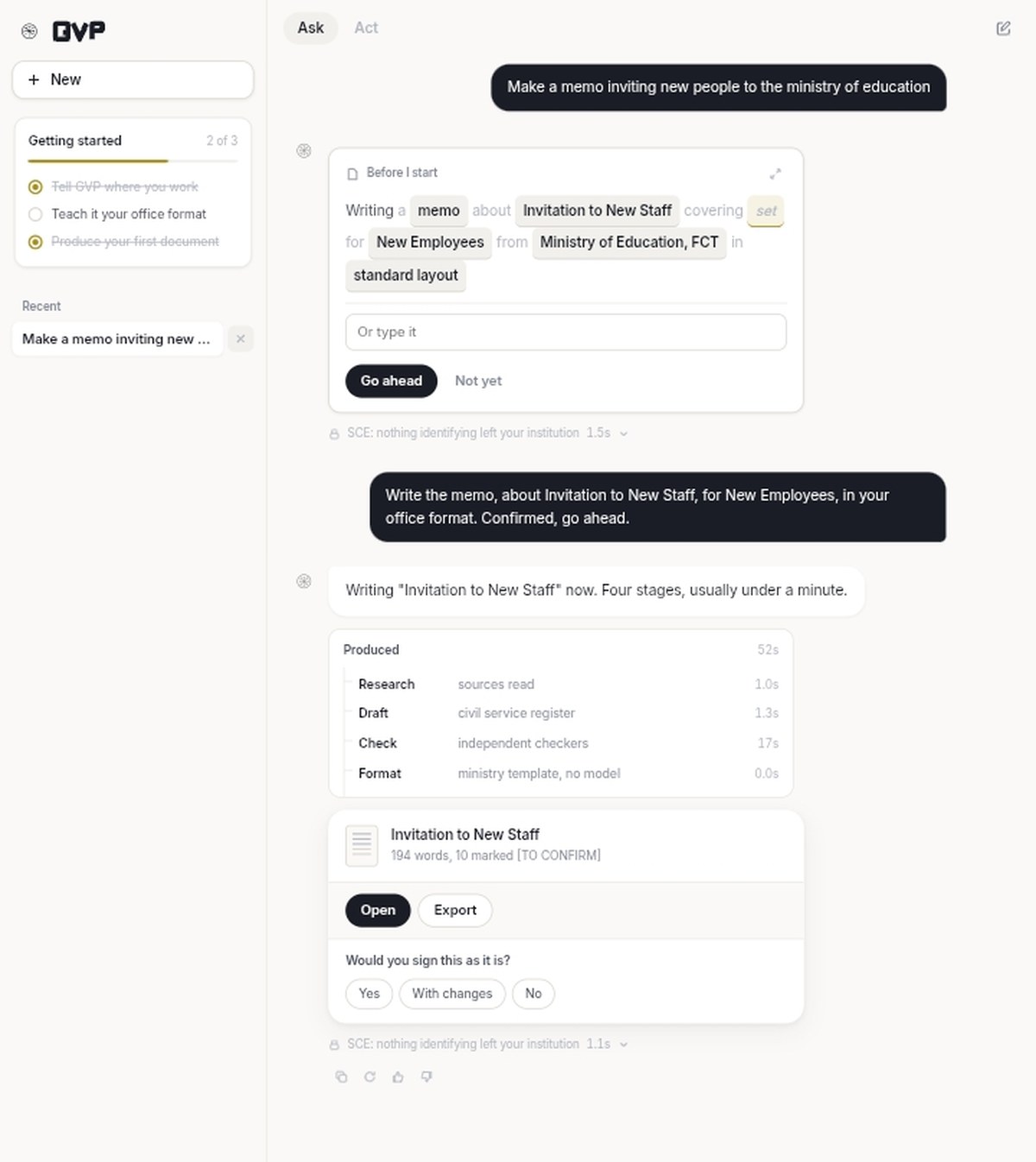
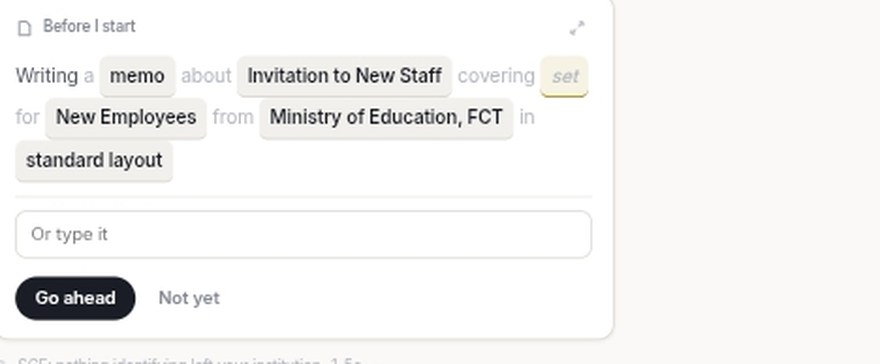
It says what it intends to write before it writes it. The kind, the period, who it is for, and in whose format.
One click sends the page open in front of you, from whatever software your office already uses. Nothing to install, nothing to integrate, and nothing about the way your office works has to change first.
It does not act on its own authority. Act reads and reports. For GVP to carry work further, the institution grants it. The limits
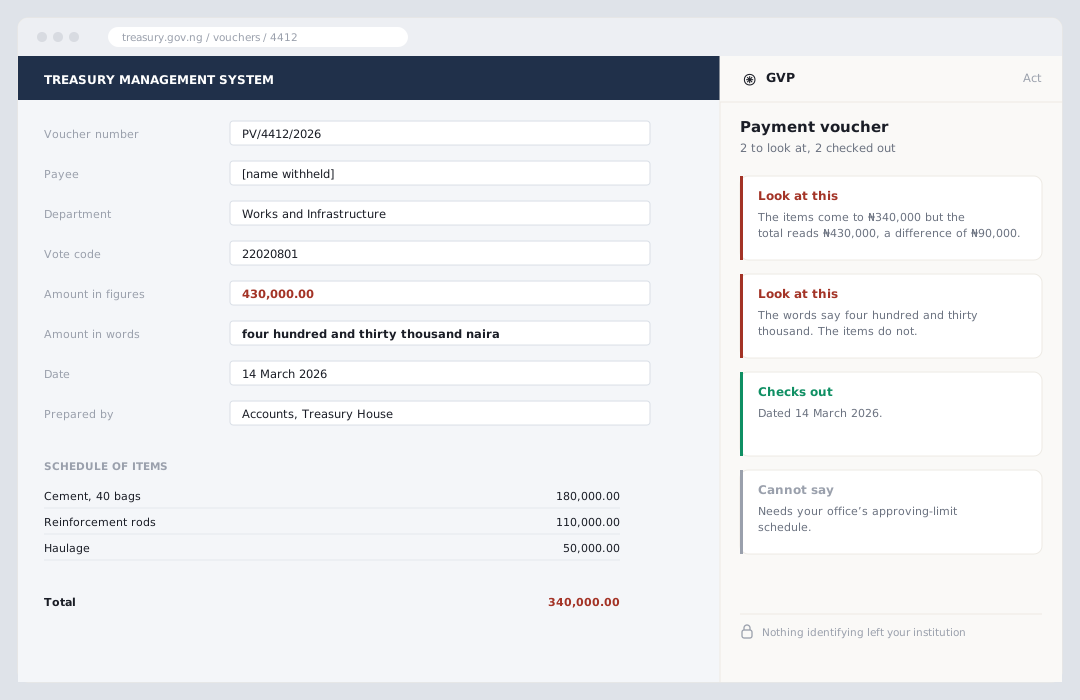
The items come to ₦340,000 but the total reads ₦430,000. Said plainly, before it leaves your desk.
A circular from the Accountant-General. A revenue receipt. A payment form. A letter from a ministry. This is the work, and GVP was built around it rather than around a general idea of paperwork.




Real documents, blurred here so that no reference number, name or amount is readable on a public page.
GVP runs in any browser and sits on your home screen like any other app. Act needs a computer, where the page and GVP can sit side by side.5
GVP is not built on one company's model. Work goes to whichever is strongest for the task, and every figure is checked by families that do not share a maker.





Every request passes through four gates before it reaches any model. Important information is removed, the crossing is recorded, and the record belongs to you. Where an institution has its own compute node, the work does not leave the building at all.
The engine beneath →Nine desks, each with the work that belongs to it. Tap a desk to see its work.
By the time the report is done, I have spent more time formatting it than actually writing it.
Formatting, collation and the second pass for errors are most of the evening.
The Governor wants a number today, and I am digging through files by hand to find it.
The figure exists. Finding it is the work.
If the AI gets a fact wrong and it goes out under my name, that is not the tool's mistake. That is mine.
Which is why every figure is checked by three families before you see it.
What changes is how much of the heavy work you can do without counting.
To see whether it writes the way your office writes
Free anywhere
Start freeFor an officer who writes often enough to stop thinking about it
About US$7.2 Paid in naira, by card or transfer, with no dollar card and no exchange spread.
UpgradeFor the institution rather than the officer
Priced against the institution, in its own currency.
See what changesNo. You start on your own, free, today. The part that acts inside a government's own software is different: that requires authority, and authority belongs to the institution rather than to any officer using it.
Yes. GVP runs in any browser and can be added to your home screen. Act, which reads the page you are working on, needs a computer, because the page and GVP have to sit side by side.
Through the Sovereign Compute Engine before it reaches any model. Important information is removed, the exchange is logged, and the record stays with your institution. Where an institution has its own compute node, the work does not leave the building at all.
Three models from different families check every figure against each other, which catches far more than any single model reviewing its own work. It is not infallible, and nothing removes your professional judgement. What it removes is the situation where you are the only check.
Act reads the page open in front of you, whatever software produced it. Nothing has to be replaced, connected or approved by anyone's IT department first.
Yes, and it becomes something larger than a licence. The institution gets its own computing environment, one format across every department, and a shared library, invoiced against its budget line.
Free, on your own, in about two minutes.
There are no prompts to learn and nothing to configure. Attach what you are working from if you have it, say what you need in plain words, and GVP takes it from there.
Before anything is produced, GVP states the kind, the subject, who it is for, who it is from and in whose format. You confirm it, or correct it, in one tap. Nothing is written on a misunderstanding.
Every piece is researched, drafted, then checked by three models from different makers, which catches far more than one model reviewing its own work. The layout is applied from your office's template, so it is exact rather than imagined.
Returns should reach this office not later than [TO CONFIRM], in the format circulated earlier.
Where GVP cannot confirm a fact, a date or a figure, it marks it for you instead of inventing it. You see exactly what needs your eye before it goes out under your name.
Ask is built for the everyday work of an office, in its own register and its own format, so what arrives on a director's desk never looks like it came from outside.
The page open in front of you goes to GVP with one click and no copying. It reads it the way a careful colleague would, and reports back beside your work.
Nothing to install and nothing to integrate. Act works on the page itself, so no one's IT department has to approve or connect anything first. It needs a computer, where the page and GVP can sit side by side.
Every page gets several checks at once, sorted into what needs your attention, what checks out, and what it honestly cannot judge from the page alone.
A total that does not add up is said in one plain sentence while there is still time to fix it, not discovered by someone further up the line.
Act reads and reports, and goes no further. Reading screenshots and anything beyond reporting are switched on by the institution, for the roles it chooses. A screenshot, when allowed, is read once and not kept.
A memorandum, a return, a circular: anything your office has already produced and approved. One example is enough to start.
It keeps the letterhead, the reference style, the numbering, the register and the sign-off, the details that tell a director the work came from inside the office.
The final layout is applied from your template, not generated by a model, so margins, numbering and headings come out the same every time.
Once learned, your format is kept with your library, so nothing arriving on a director's desk looks like it came from outside.
Your request is read here, before anything is sent anywhere. The engine works out what in it identifies a person, an account or a reference.
Important information is replaced before it leaves, and put back when the work returns. The figures are untouched, so the work still comes back correct.
Only the stripped text travels, and only to where your institution's policy allows. Where it has its own compute node, the work goes there first, and can be required never to leave it.
What crossed, and when, is written to your institution's own record. We record that work happened, never what it said.
Your own compute nodeEvery office runs its desks a little differently. Show GVP one piece your desk has already issued, and it learns your format from the first day. Free to start, on your own.
Start free